Why Were Computers Locked In Special Rooms?
Alexander's grandfather — everyone simply called him Grandad — had a habit of answering big questions with a story, and one evening the boy gave him the biggest question yet.
"Grandad, how did we get from the computers of World War Two to ChatGPT?"
Grandad smiled the way he always did before a long answer. "That story starts long before phones, laptops, websites, and AI assistants," he said. "It starts in a room you've never seen, with a machine you wouldn't recognize."
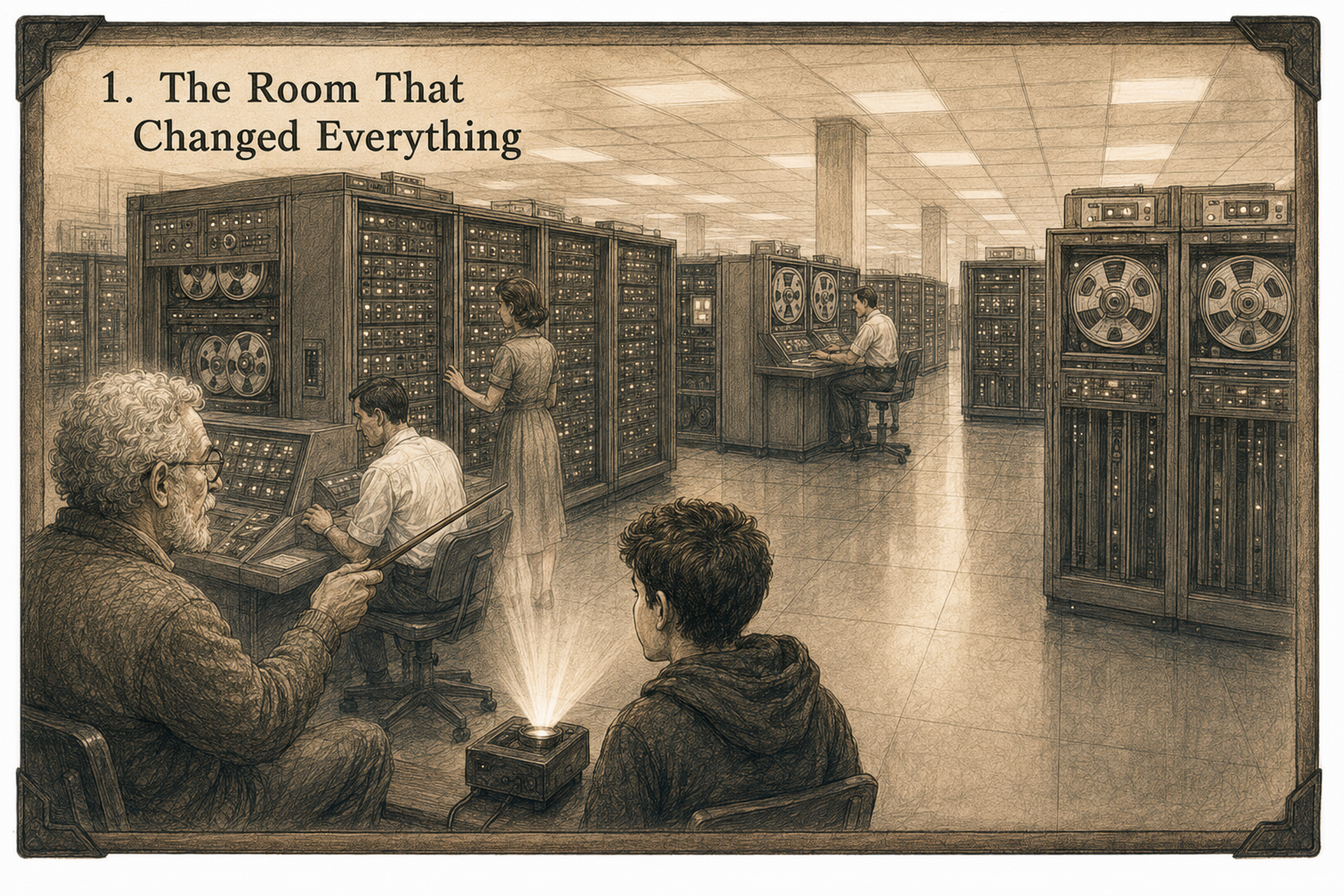
Back then, he explained, a computer was not something you carried in your pocket. A computer could fill an entire room. Some weighed several tons. Some used thousands of vacuum tubes, generated enormous heat, and broke down more often than anyone liked to admit.
And they were expensive — not expensive the way a new phone is expensive, but expensive the way a building is expensive. Governments used them. Universities used them. Large corporations used them. Ordinary people rarely even saw one.
Because they were valuable and fragile, computers were often kept in special rooms, with access controlled, temperature controlled, and the whole environment controlled, as if the machine itself were something delicate and half-alive.
"What did they not have, back then?" Grandad asked, and answered before the boy could guess. No apps. No browsers. No Wi-Fi. No social media. No touch screens. No desktop icons. Most people never touched the machine directly at all.
Instead, they prepared instructions ahead of time, often stored on punch cards — stiff little rectangles where information was represented by patterns of holes. A stack of cards could contain an entire program. And if that stack fell on the floor and got mixed up, the program could fail completely, with no warning and no mercy.
The cards were given to an operator, who loaded the job into the machine. The computer processed the job. Hours later, the results appeared. If there was a mistake, the entire process started again from the beginning.
And yet, for all their trouble, these machines changed the world. They helped scientists, governments, and businesses, and they proved — slowly, expensively — that computers were useful.
Once people knew that, Grandad said, they immediately wanted something better. They wanted faster answers, more direct communication, real interaction. That desire would create the next revolution.
"The terminal," Grandad said quietly, and Alexander leaned forward, because he could tell that was where the next story began.
What You Should Remember
Early computers filled rooms. They were expensive. They used punch cards. Results could take hours. People wanted a faster way to communicate with computers.